Mostrar mensagens com a etiqueta televisão. Mostrar todas as mensagens

22/02/17

© Justin Tallis / AFP, 2016

"A política..., no fundo, para que serve a política?! Porque precisamos de elites políticas? Porque no fundo o tempo é uma espécie de grande oceano. Os povos navegam num gigantesco oceano que é sempre um oceano de incertezas chamado tempo. E os políticos deveriam ser os nossos navegadores. Os nossos argonautas. E quando os governos funcionam bem, nós temos governos com visão. Temos lideres que têm visão (...) capazes de ver para lá do horizonte imediato. A questão fundamental é que nós, na Europa, há pelo menos 6 ou 7 anos que riscámos do léxico político-europeu a palavra FUTURO. Inclusivamente até riscámos do léxico europeu a ideia de FUTURO COMUM. A ideia de PAZ. De SOLIDARIEDADE. E quando a política deixa de ter uma ideia de comum, quando, no fundo, a política deixa de ser concebida como a capacidade de unir as pessoas, na sua diferença, em nome de um projecto de futuro, essa política tem de ser alterada."  

Viriato Soromenho-Marques, in Europa 30 - Democracia

08/12/16


realização de Everardo Gout | Mars, 2016
banda sonora original de Nick Cave e Warren Ellis

22/02/16

© Miguel Bartolomeu | Ricardo & Cindy, 2015

É isso que é o amor. Não há nenhuma resposta clara para isso. Quando se reconhece que há alguém mais importante que nós, decidimos, se pudermos, ligar as duas vidas uma à outra. (...) Há um ponto em que a razão expira, em que as opções deixam de ser racionais. Devemos usar a razão, mas não para além do ponto em que ela perde o sentido. E claro, um casamento ou uma relação entre pessoas, obriga-nos a pensar muitas coisas. Mas chega a altura em que todas as razões pró e contra se esgotaram e só nessa altura nos rendemos à vida e ela se torna uma coisa de suprema importância, mas é a vida de um ser consciente de si próprio, não apenas um animal. (...) Ter este sentimento para com outra pessoa e estarem ambos preparados para isto, já é automaticamente viver acima dessa rotina quotidiana, sair dela e experimentar algo sublime.

Roger Scruton, in O Belo e a Consolação

30/09/15


© Lisa Cholodenko | Olive Kitteridge, 2014


Life is a messy odyssey that straddles the line between comedy and pathos. 

Lisa Cholodenko

27/02/15

© Marion Ettlinger | Siri Hustvedt


After reading the essays collected in this book, I understood that although they take on a number of subjects, they are linked by an abiding curiosity about what it means to be human. How do you see, remember, feel, and interact with other people? What does it mean to sleep, to dream, and to speak? When we use the word self, what are we talking about?
(...)
It is importante to remember that despite the plethora of solutions, who we are and how we got that way remain open queries, not only in the humanities but in the sciences as well.

Siri Hustvedt, in Living,Thinking, Looking - essays


"O Valor da Liberdade - diálogos sobre as possibilidades do humano" com Siri Hustvedt, sábado 28, na SIC Notícias, às 20h. Repete domingo, às 14h30 e 01h30.

21/02/15


A história é o registo do aumento das liberdades? A liberdade depende do desenvolvimento? A riqueza e a desigualdade ameaçam a liberdade? A tecnologia emancipa ou aprisiona? As liberdades mudam de geração para geração? A experiência da liberdade depende da geografia? A arte expressa e antecipa as liberdades? As crises e a violência comprometem a liberdade? As utopias emancipam ou alienam? A liberdade humana tem futuro? Que novas liberdades queremos inventar?  

Estreia hoje
e
repete aos domingos,

aqui

21 FEV. Gilles Lipovetsky | 28 FEV. Siri Hustvedt | 07 MAR. Dani Rodrik | 14 MAR. John Gray | 21 MAR. Pedro Ferreira | 28 MAR. Seyla Benhabib | 04 ABR. Fernando Henrique Cardoso | 11 ABR. Mark Mazower | 18 ABR. Antony Beevor | 25 ABR. Francisco Bethencourt

04/02/15

Jeff Bridges: Sleeping Tapes, 2015


“J’aime écouter des sons intriguants quand je m’enfonce dans mes rêves”. Jeff Bridges, alias The Dude dans “The Big Lebowski” vient de sortir “Sleeping Tapes” avec l’aide du compositeur Keefus Ciancia, auteur notamment de la BO de True Detective. Les 15 titres, qui peuvent être écoutés sur Internet, doivent aider l’auditeur à s’endormir, même si ils peuvent “être écoutés à n’importe quel moment de la journée”, a expliqué l’acteur.
Les bénéfices de l’album seront reversés à l’association “No Kid Hungry” qui lutte contre la sous-alimentation des enfants aux Etats-Unis. Toujours aussi cool The Dude.

in Les Inrockuptibles

23/05/14

la serie sorpresa de la temporada.

Martin Freeman in Fargo, 2014


"Fargo, la serie, es una auténtica sorpresa. Eso en principio es buena señal, aunque a veces sucede que la crítica ensalza un producto que a uno no le llega por el motivo que sea. A fin de cuentas, cada espectador es un mundo y cada crítico también. Pero en este caso he de sumarme al coro generalizado de voces entusiastas. Aunque carece de sentido comparar el largometraje original y el show televisivo (porque aquella película es mucha película, desde luego), esta serie es una hija más que merecedora del nombre de su padre. No solamente ha conseguido la improbable proeza de capturar el universo Coen sin desvirtuarlo, sino que lo ha llevado a otro formato con tal habilidad y derroche de talento que todo el escepticismo inicial va siendo demolido, golpe a golpe, conforme transcurren los episodios." 

Emilio de Gorgot, aqui. 

20/04/14

This... This is what I'm talking about.

HBO, 2014


This is what I mean when I'm talkin' about time, and death, and futility.

To realize that all your life, all your love, all your hate, all your memories, all your pain, it was all the same thing. It was all the same dream, a dream that you had inside a locked room, a dream about being a person. And like a lot of dreams, there's a monster at the end of it. 

Rust Cohle, in True Detetctive

23/03/14

HBO | True Detective, 2014

"My life's been a circle of violence and degradation, long as I can remember. I'm ready to tie it off." 
Rustin Cohle in True Detective

13/02/14

We've got to take a chance.

© Roger Mertin, 1968
© Cornell Capa, 1958

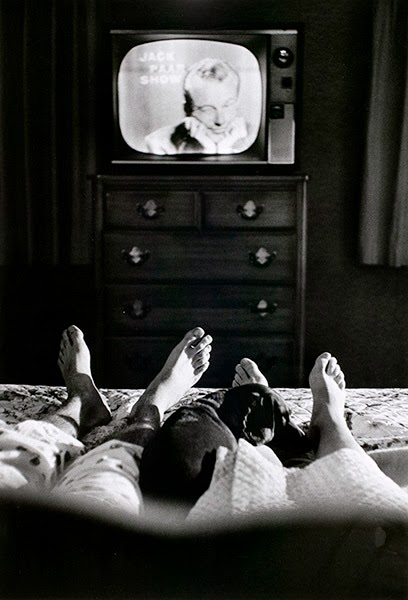
Alfred Mac Adam: Television is being criticized as the ruination of twentieth-century life, but you have the unique opinion that television will be good for poetry as a return to the oral tradition.

Octavio Paz: Poetry existed before writing. Essentially, it is a verbal art, that enters us not only through our eyes and understanding but through our ears as well. Poetry is something spoken and heard. It's also something we see and write. In that we see the importance in the Oriental and Asian traditions of calligraphy. In the West, in modern times, typography has also been important—the maximum example in this would be Mallarmé. In television, the aural aspect of poetry can join with the visual and with the idea of movement—something books don't have. Let me explain: this is a barely explored possibility. So I'm not saying television will mean poetry's return to an oral tradition but that it could be the beginning of a tradition in which writing, sound, and images will unite. Poetry always uses all the means of communication the age offers it: musical instruments, printing, radio, records. Why shouldn't it try television? We've got to take a chance.

Octavio Paz, in The Art of Poetry No. 42

10/02/14

House of Cards is a very dark show.

© Netflix | House of Cards

“And this season, it gets darker.

Adam Sternbergh

to eat, sleep and dream House of Cards

© Carolyn Cole| Beau Willimon

Obviously, the job of any TV show runner is an immersive, even overwhelming one, but I believe this is truer for Willimon, who seems to eat, sleep and dream “House of Cards.” The first line of the bio on his Twitter page reads, “This is how I’ve spent the last four years of my life,” and then there’s a link to the “House of Cards” Twitter account.

Adam Sternbergh, aqui.

12/01/14

© Netflix | House of Cards, 2013

Francis Underwood: There are two kinds of pain. The sort of pain that makes you strong, or useless pain. The sort of pain that's only suffering. I have no patience for useless things.

20/03/13

© Fred Herzog, 1968

Alfred Mac Adam: Television is being criticized as the ruination of twentieth-century life, but you have the unique opinion that television will be good for poetry as a return to the oral tradition.

Octavio Paz: Poetry existed before writing. Essentially, it is a verbal art, that enters us not only through our eyes and understanding but through our ears as well. Poetry is something spoken and heard. It's also something we see and write. In that we see the importance in the Oriental and Asian traditions of calligraphy. In the West, in modern times, typography has also been important—the maximum example in this would be Mallarmé. In television, the aural aspect of poetry can join with the visual and with the idea of movement—something books don't have. Let me explain: this is a barely explored possibility. So I'm not saying television will mean poetry's return to an oral tradition but that it could be the beginning of a tradition in which writing, sound, and images will unite. Poetry always uses all the means of communication the age offers it: musical instruments, printing, radio, records. Why shouldn't it try television? We've got to take a chance.

Octavio Paz, in The Art of Poetry No. 42